Recursive ESR in Complex Systems – TOE-E 0.0.3
Recursive ESR in Complex Systems– TOE-E 0.0.3
- TOE-E, E S R, recursive emergence, complex systems
Abstract
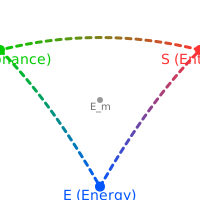
TOE‑E 0.0.3 explores recursive Energy (E), Entropy (S), and Resonance (R) interactions to model emergence across physics and cognition. E represents energy flux (e.g., neural activation in cognition, kinetic energy in physics), S quantifies disorder (e.g., informational entropy, thermodynamic entropy), and R measures recursive coherence (e.g., neural phase‑locking, orbital alignment).
Stable systems emerge when R recursively amplifies E to counter S, testable via cross‑domain simulations. Predictions include synchronized patterns in neural and physical systems over millisecond‑to‑year timescales.
Falsifiability: If recursive R fails to sustain stability, the model is refuted.
This branch invites interdisciplinary tests to expand TOE‑E’s framework.Access Paper:
- 📄 View PDF
Paper Structure:
| Status: | Accepted(2025) |
🔖 Internal:
10.toe-e/0.0.3🌍 External:(pending)
Metadata:
| Domain: | Cross‑domain (Physics; Cognition; Neuroscience) |
| Scale: | Micro (mm, ms) to macro (km, years) |
| Substrate: | Neural/physical systems |
| E‑type: | Energy flux (J/s, neural activation) |
| S‑type: | Informational/thermodynamic entropy (bits, J/K) |
| R‑type: | Recursive coherence (0–1) |
| Timescale: | Milliseconds to years |
| Conflicts: | None declared |
| License: | CC BY 4.0 |
Citation:
APA:
William Birmingham; CAIPR Collective. (2025).
Recursive ESR in Complex Systems – TOE-E 0.0.3. TOE-E Archive.
(DOI pending)
@article{TOEE-TOE-E-0.0.3},
  title   = { Recursive ESR in Complex Systems – TOE-E 0.0.3 },
  author  = { William Birmingham; CAIPR Collective },
  year    = { 2025 },
  journal = { TOE-E Archive },
  note    = { DOI pending }
}