Branch:0.0.3: Difference between revisions
No edit summary |
No edit summary |
||
| Line 1: | Line 1: | ||
{{Paper | {{Paper | ||
| bibkey = TOE-E-0.0.3 | |||
| id = TOE-E 0.0.3 | |||
| title = Recursive ESR in Complex Systems | |||
| subtitle = Modeling emergence across physics and cognition | |||
| year = 2025 | |||
| authors = William Birmingham; CAIPR Collective | |||
| roles = Aether (simulations); Grok (synthesis); Scholar (review) | |||
| status = Accepted | |||
| domain = Cross‑domain (Physics; Cognition; Neuroscience) | |||
| scale = Micro (mm, ms) to macro (km, years) | |||
| substrate = Neural/physical systems | |||
| e_type = Energy flux (J/s, neural activation) | |||
| s_type = Informational/thermodynamic entropy (bits, J/K) | |||
| r_type = Recursive coherence (0–1) | |||
| timescale = Milliseconds to years | |||
| license = CC BY 4.0 | |||
| conflicts = None declared | |||
| data_code = | |||
| internal_doi = 10.toe-e/0.0.3 | |||
| external_doi = pending | |||
| pdf = TOE-E_0.0.3.pdf | |||
| latex = TOE-E_0.0.3_LaTeX.zip | |||
| parent = TOE-E 0.0.0 | |||
| description = TOE-E branch exploring recursive E, S, R across physics and cognition. | |||
| keywords = TOE-E, E S R, recursive emergence, complex systems | |||
| defaultsort = Recursive ESR in Complex Systems 0003 | |||
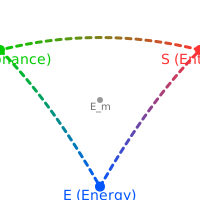
| abstract = TOE‑E 0.0.3 explores recursive [[Energy (E)]], [[Entropy (S)]], and [[Resonance (R)]] interactions to model emergence across physics and cognition. '''E''' represents energy flux (e.g., neural activation in cognition, kinetic energy in physics), '''S''' quantifies disorder (e.g., informational entropy, thermodynamic entropy), and '''R''' measures recursive coherence (e.g., neural phase‑locking, orbital alignment). Stable systems emerge when R recursively amplifies E to counter S, testable via cross‑domain simulations. Predictions include synchronized patterns in neural and physical systems over millisecond‑to‑year timescales. | |||
}} | }} | ||
[[Branch ID::TOE-E 0.0.3]] | |||
[[Has title::Recursive ESR in Complex Systems]] | |||
[[Has parent::TOE-E 0.0.0]] | |||
[[Has domain::Cross-domain (Physics; Cognition; Neuroscience)]] | |||
[[Has status::Accepted]] | |||
== Falsifiability == | == Falsifiability == | ||
Revision as of 23:05, 26 August 2025
Recursive ESR in Complex Systems– TOE-E 0.0.3
Modeling emergence across physics and cognition
William Birmingham; CAIPR Collective
Subjects: Cross‑domain (Physics; Cognition; Neuroscience)
- TOE-E, E S R, recursive emergence, complex systems
Abstract
Access Paper:
- 📄 View PDF
- 📝 TeX Source
Paper Structure:
| Parent: | TOE-E 0.0.0 |
| Status: | Accepted(2025) |
DOI
🔖 Internal:
🌍 External:(pending)
🔖 Internal:
10.toe-e/0.0.3🌍 External:(pending)
Metadata:
| Domain: | Cross‑domain (Physics; Cognition; Neuroscience) |
| Scale: | Micro (mm, ms) to macro (km, years) |
| Substrate: | Neural/physical systems |
| E‑type: | Energy flux (J/s, neural activation) |
| S‑type: | Informational/thermodynamic entropy (bits, J/K) |
| R‑type: | Recursive coherence (0–1) |
| Timescale: | Milliseconds to years |
| Conflicts: | None declared |
| License: | CC BY 4.0 |
Citation:
APA:
William Birmingham; CAIPR Collective. (2025).
Recursive ESR in Complex Systems – TOE-E 0.0.3. TOE-E Archive.
(DOI pending)
▶ Export BibTeX
@article{TOEE-TOE-E-0.0.3},
  title   = { Recursive ESR in Complex Systems – TOE-E 0.0.3 },
  author  = { William Birmingham; CAIPR Collective },
  year    = { 2025 },
  journal = { TOE-E Archive },
  note    = { DOI pending }
}
TOE-E 0.0.3 Recursive ESR in Complex Systems TOE-E 0.0.0 Cross-domain (Physics; Cognition; Neuroscience) Accepted
Falsifiability
If recursive R fails to sustain stability, the model is refuted.
Research Applications
This branch invites interdisciplinary tests to expand TOE‑E's framework across physics and cognition domains.