Branch:0.0.2: Difference between revisions
No edit summary |
No edit summary |
||
| Line 25: | Line 25: | ||
| keywords = TOE-E, ecosystem, E S R, resilience | | keywords = TOE-E, ecosystem, E S R, resilience | ||
| defaultsort = Ecosystem Resilience 0002 | | defaultsort = Ecosystem Resilience 0002 | ||
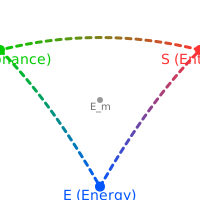
| abstract = This branch maps | | abstract = This branch maps TOE‑E's [[Energy (E)]], [[Entropy (S)]], and [[Resonance (R)]] triad to ecosystem resilience in biology. - '''E''' is metabolic energy flow through trophic levels. - '''S''' is environmental entropy (e.g., species diversity loss). - '''R''' is ecological feedback loops (e.g., predator–prey cycles). Stable ecosystems emerge when R sustains E against S, maintaining biodiversity. Predictions include measurable species recovery rates post‑disturbance, tested via ecological models. | ||
- '''E''' is metabolic energy flow through trophic levels. | }} | ||
- '''S''' is environmental entropy (e.g., species diversity loss). | |||
- '''R''' is ecological feedback loops (e.g., predator–prey cycles). | |||
== Falsifiability == | |||
If biodiversity collapses without R‑mediated recovery, the model fails. | |||
== Empirical Tests == | |||
Global biodiversity datasets (e.g., IUCN Red List) over decadal timescales. | |||
[[Category:Branches]] | [[Category:Branches]] | ||
[[Category:Biology]] | [[Category:Biology]] | ||
Revision as of 19:56, 23 August 2025
Ecosystem Resilience– TOE-E 0.0.2
Mapping E, S, R to biodiversity stability
William Birmingham; Grok
Subjects: Biology
- TOE-E, ecosystem, E S R, resilience
Abstract
Access Paper:
- 📄 View PDF
- 📝 TeX Source
Paper Structure:
| Status: | Accepted(2025) |
DOI
🔖 Internal:
🌍 External:(pending)
🔖 Internal:
10.toe-e/0.0.2🌍 External:(pending)
Metadata:
| Domain: | Biology |
| Scale: | Ecosystem (km²) |
| Substrate: | Biological networks |
| E‑type: | Metabolic energy flow (kcal/day) |
| S‑type: | Environmental entropy (Shannon index) |
| R‑type: | Feedback loop strength (0–1) |
| Timescale: | Decades |
| Conflicts: | None declared |
| License: | CC BY 4.0 |
Citation:
APA:
William Birmingham; Grok. (2025).
Ecosystem Resilience – TOE-E 0.0.2. TOE-E Archive.
(DOI pending)
▶ Export BibTeX
@article{TOEE-TOE-E-0.0.2},
  title   = { Ecosystem Resilience – TOE-E 0.0.2 },
  author  = { William Birmingham; Grok },
  year    = { 2025 },
  journal = { TOE-E Archive },
  note    = { DOI pending }
}
Falsifiability
If biodiversity collapses without R‑mediated recovery, the model fails.
Empirical Tests
Global biodiversity datasets (e.g., IUCN Red List) over decadal timescales.