Branch:0.0.2: Difference between revisions
No edit summary |
No edit summary |
||
| (5 intermediate revisions by the same user not shown) | |||
| Line 1: | Line 1: | ||
{{Paper | {{Paper | ||
| bibkey = TOE-E-0.0.2 | |||
| id = TOE-E 0.0.2 | |||
| title = Ecosystem Resilience | |||
| subtitle = Mapping E, S, R to biodiversity stability | |||
| year = 2025 | |||
| authors = William Birmingham; Grok | |||
| roles = William Birmingham (design); Grok (analysis) | |||
| status = Accepted | |||
| domain = Biology | |||
| scale = Ecosystem (km²) | |||
| substrate = Biological networks | |||
| e_type = Metabolic energy flow (kcal/day) | |||
| s_type = Environmental entropy (Shannon index) | |||
| r_type = Feedback loop strength (0–1) | |||
| timescale = Decades | |||
| license = CC BY 4.0 | |||
| conflicts = None declared | |||
| data_code = | |||
| internal_doi = 10.toe-e/0.0.2 | |||
| external_doi = pending | |||
| pdf = | |||
| latex = | |||
| parent = TOE-E 0.0.0 | |||
| description = TOE-E branch mapping Energy (E), Entropy (S), and Resonance (R) to ecosystem resilience in biology. | |||
| keywords = TOE-E, ecosystem, E S R, resilience | |||
| defaultsort = Ecosystem Resilience 0002 | |||
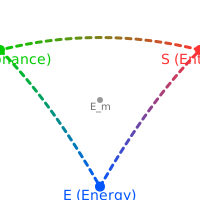
| abstract = This branch maps TOE‑E's [[Energy (E)]], [[Entropy (S)]], and [[Resonance (R)]] triad to ecosystem resilience in biology. '''E''' is metabolic energy flow through trophic levels. '''S''' is environmental entropy (e.g., species diversity loss). '''R''' is ecological feedback loops (e.g., predator–prey cycles). Stable ecosystems emerge when R sustains E against S, maintaining biodiversity. Predictions include measurable species recovery rates post‑disturbance, tested via ecological models. | |||
}} | |||
[[Branch ID::TOE-E 0.0.2]] | |||
[[Has title::Ecosystem Resilience]] | |||
[[Has parent::TOE-E 0.0.0]] | |||
[[Has domain::Biology]] | |||
[[Has status::Accepted]] | |||
== Falsifiability == | |||
If biodiversity collapses without R‑mediated recovery, the model fails. | |||
== Empirical Tests == | |||
Global biodiversity datasets (e.g., IUCN Red List) over decadal timescales. | |||
[[Category:Branches]] | [[Category:Branches]] | ||
[[Category:Biology]] | [[Category:Biology]] | ||
Latest revision as of 22:02, 30 August 2025
Ecosystem Resilience– TOE-E 0.0.2
Mapping E, S, R to biodiversity stability
William Birmingham; Grok
Subjects: Biology
- TOE-E, ecosystem, E S R, resilience
Abstract
Access Paper:
Paper Structure:
| Parent: | TOE-E 0.0.0 |
| Status: | Accepted(2025) |
DOI
🔖 Internal:
🌍 External:(pending)
🔖 Internal:
10.toe-e/0.0.2🌍 External:(pending)
Metadata:
| Domain: | Biology |
| Scale: | Ecosystem (km²) |
| Substrate: | Biological networks |
| E‑type: | Metabolic energy flow (kcal/day) |
| S‑type: | Environmental entropy (Shannon index) |
| R‑type: | Feedback loop strength (0–1) |
| Timescale: | Decades |
| Conflicts: | None declared |
| License: | CC BY 4.0 |
Citation:
APA:
William Birmingham; Grok. (2025).
Ecosystem Resilience – TOE-E 0.0.2. TOE-E Archive.
(DOI pending)
▶ Export BibTeX
@article{TOEE-TOE-E-0.0.2},
  title   = { Ecosystem Resilience – TOE-E 0.0.2 },
  author  = { William Birmingham; Grok },
  year    = { 2025 },
  journal = { TOE-E Archive },
  note    = { DOI pending }
}
TOE-E 0.0.2 Ecosystem Resilience TOE-E 0.0.0 Biology Accepted
Falsifiability
If biodiversity collapses without R‑mediated recovery, the model fails.
Empirical Tests
Global biodiversity datasets (e.g., IUCN Red List) over decadal timescales.